Visual EM

Inferior Rectus Abscess CT Coronal Unannotated. JETem 2025
Visual EM, Infectious Disease, Ophthalmology

A Case Report of Inferior Rectus Abscess

Non-contrast computed tomography (CT) imaging of the head in coronal, sagittal, and axial planes revealed a distinct 1.7 x 2.2 x 1.4 cm peripherally enhancing fluid collection within the left inferior orbit, involving the inferior rectus (yellow circle). This lesion resulted in restricted extraocular motility due to structural compression of the left globe. Laboratory results showed a mildly elevated white blood cell count of 11.5/mm3 and otherwise normal results including C-reactive protein (CRP) and erythrocyte sedimentation rate (ESR).

Hydropic Gallbladder. CT Coronal Unannotatd. JETem 2025
Visual EM, Abdominal/Gastroenterology, Infectious Disease

A Case Report of Hydropic Gallbladder Presenting as Right Lower Quadrant Abdominal Pain

Computed tomography (CT) of the abdomen and pelvis with contrast was ordered, and general surgery was consulted for the initial working diagnosis of acute appendicitis. However, the CT scan resulted with findings of a markedly distended gallbladder measuring approximately 14.5 x 4 centimeters (cm) with marked gallbladder wall thickening (magenta) and pericholecystic fat stranding (cyan). The appendix was not dilated and had no inflammatory changes or edema. Follow-up right upper quadrant ultrasound confirmed the diagnosis of acute cholecystitis.

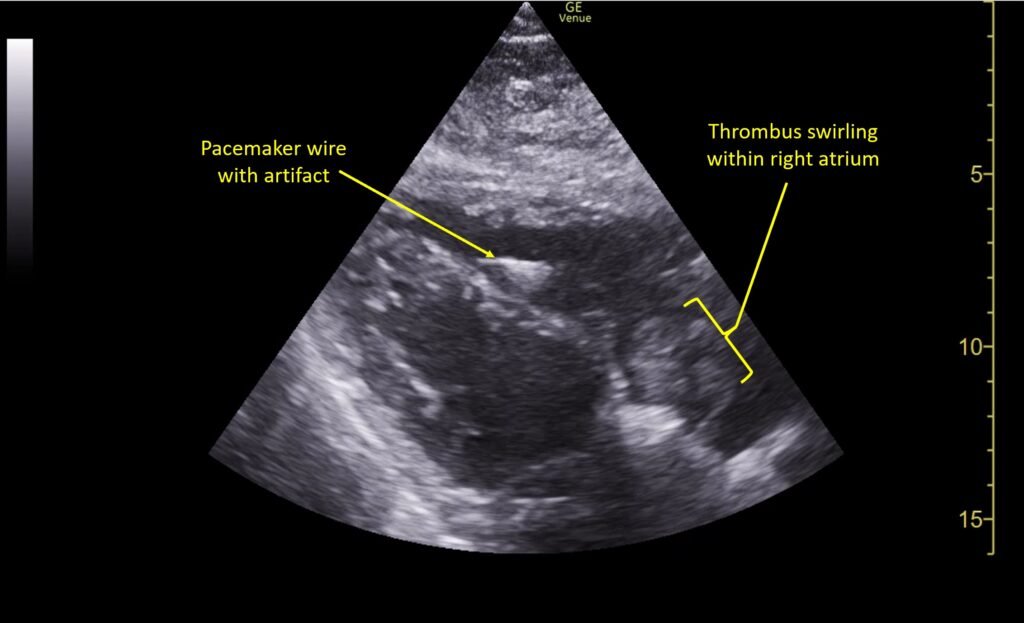
Wolff A et al. Right atrial thrombosis. Parasternal long US 3 annotated
Visual EM, Cardiology/Vascular, Ultrasound

A Case Report of Right Atrial Thrombosis Complicated by Multiple Pulmonary Emboli: POCUS For the Win!

Pulmonary POCUS was performed by the ED physician (GE Venue, C1-5-RS 5MHz curvilinear transducer), and lung examination was unremarkable with no pleural effusion, pneumothorax, or infiltrate. Subxiphoid views (GE Venue, 3Sc-RS 4MHz phased-array transducer) were obtained because this patient’s COPD with severe pulmonary hyperexpansion made parasternal and apical 4-chamber views suboptimal. A large thrombus can be seen within the right atrium (movie 1, images 1, 2). This has a serpiginous, rounded appearance and is mobile, appearing to swirl within the right atrium with intermittent extrusion through the tricuspid valve. A pacemaker wire is also visible within the right ventricle as a non-moving, hyperechoic, linear structure with posterior enhancement artifact. Pericardial effusion is not present.

Dermatomyositis Face. JETem 2024
Visual EM, Dermatology

A Case Report on Dermatomyositis in a Female Patient with Facial Rash and Swelling

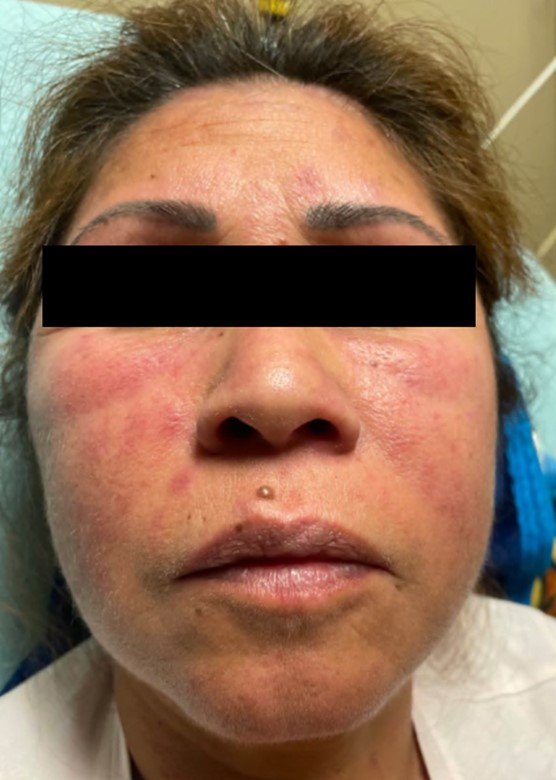
The physical exam revealed significant periorbital swelling, facial edema, and a maculopapular rash across the upper chest, symmetrically across the extensor surfaces of the hands and the bilateral arms and thighs. The photograph of her face shows light-red to violaceous macules and patches, with inclusion of the nasolabial folds as well the forehead and upper eyelids with periorbital edema (heliotrope sign). The other rash images show “Shawl sign” (photograph of back showing erythema over the posterior aspect of the upper back), V sign (photograph of chest showing light-red violaceous plaque on mid-chest), Gottron’s papules (photograph of hands showing light red scaly papules overlying the right proximal interphalangeal joint [R PIP] and the metacarpophalangeal joint [MCP], and holster sign (photograph of thigh showing light red patches on bilateral lateral thighs). This distribution of rashes is pathognomonic for DM.

Vulvar Hematoma. CT Coronal Unannotated. JETem 2024
Visual EM, Ob/Gyn

Computed Tomography Findings in Non-Obstetric Vulvar Hematoma: A Case Report

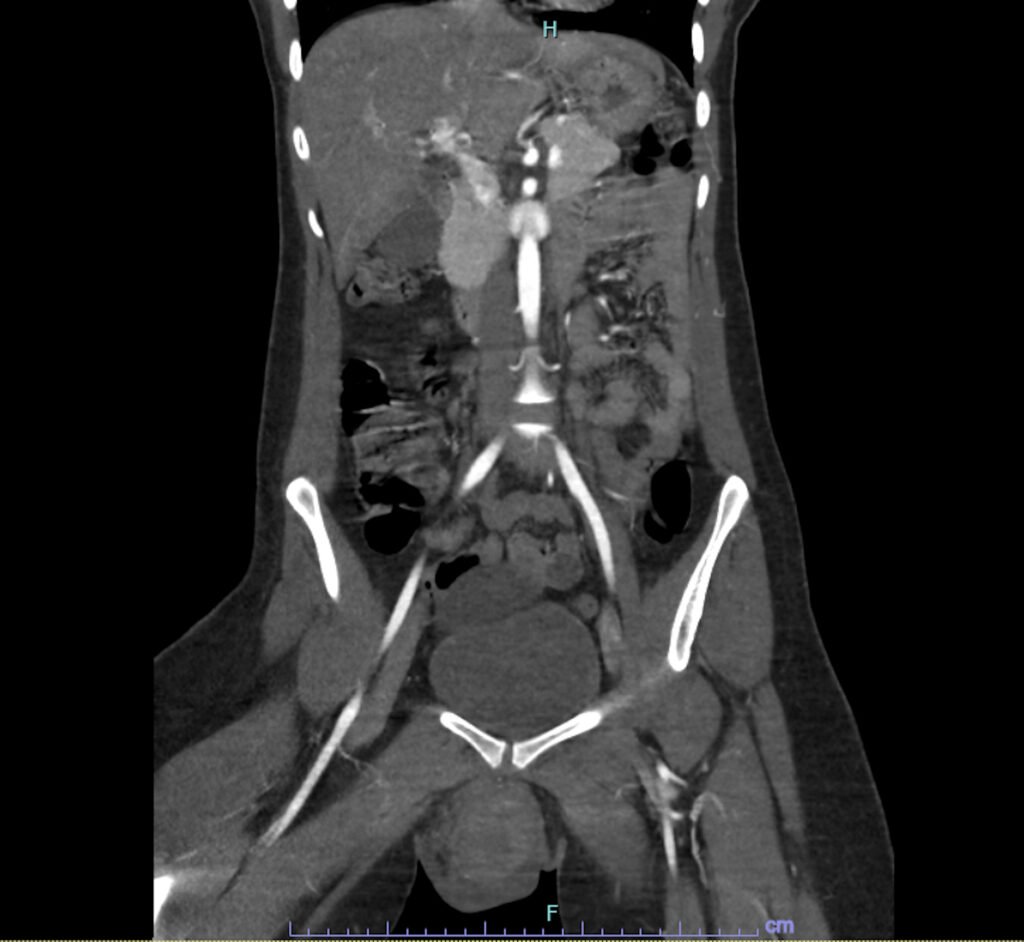
Bedside ultrasound was first used to evaluate for evidence of abscess or cyst formation. Ultrasound demonstrated a hypoechoic area within the right labia without evidence of a cyst or abscess wall. Based on these findings, an angiogram CT of the pelvis was obtained which revealed a vulvar hematoma with evidence of active arterial extravasation. In both the coronal and axial view, there is an asymmetric area of isodensity in the right labia representing a hematoma (blue circled area). Angiography may show areas of active extravasation, which appears as hyperdensity within the area of hematoma (see red arrow in coronal plane).

Scroll to Top